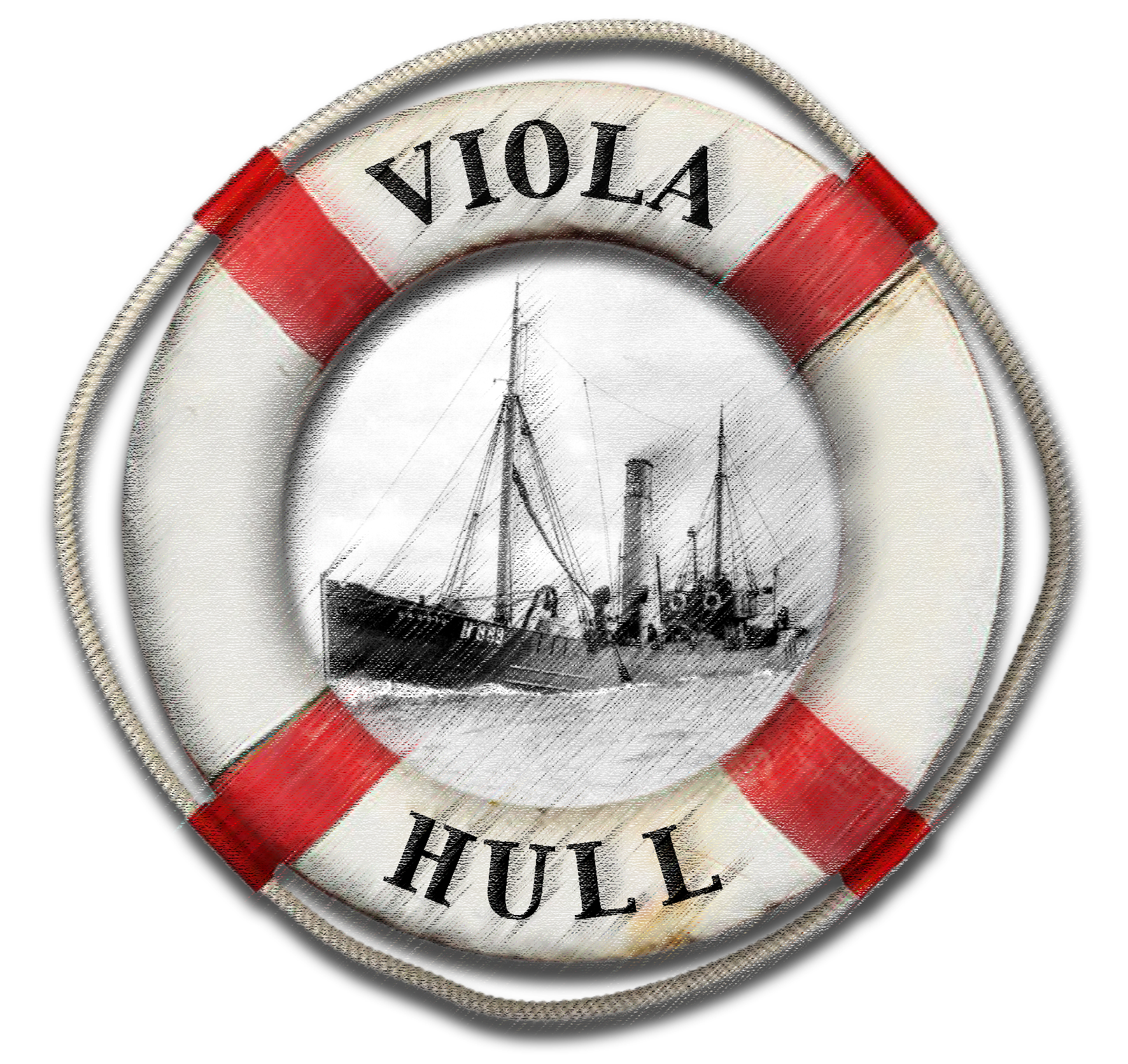
Facts

Built in 1906 as a steam trawler in Beverley, Viola was originally part of a North Sea boxing fleet operated by the Hellyer Steam Fishing Company of Hull. Charles Hellyer, the owner named almost every vessel in his fleet after Shakespearean characters.

  • Launched 17th January 1906 by Cook Welton and Gemmell shipyard in Beverley for the Hellyer Steam Fishing Company. Now the oldest surviving steam trawler in the world with its steam engines still intact.
  • Sister ship Antonio, built alongside Viola in Beverley, disappeared with all hands on its second voyage.
  • Hull North Sea boxing fleet trawler from 1906 – 1914. Supplied fresh fish mainly for the Billingsgate market in London.
  • Requisitioned by the Admiralty in September 1914. As HMT Viola spent more than four years in the Auxiliary Patrol on anti-submarine duties with a crew of fishermen reservists.
  • Numerous hostile encounters with U-boats. Viola’s skipper Charles Allum was Mentioned in Despatches for rescuing the crew of a sinking French vessel and for driving off a U-boat attacking a neutral Norwegian steamer.
  • One of the first tranche of vessels fitted with hydrophones and depth charges and, with air support, participated in the sinking of the UB-30 and UB-115 in 1918.
  • Sold to A/S Sandefjord Trawlfiskeselskap in 1920 as a working trawler and renamed Kapduen (Cape Petrel). Based in Sandefjord, Norway and worked in fishing and towing duties.
  • Came under the ownership of veteran Norwegian whaler, Nils Torvald Olonso, in 1923. Converted to a whale catcher and operated along the African coast until 1925.
  • Renamed Dias in 1927 after being sold to Compania Argentina de Pesca (Pesca) and registered in Buenos Aires. After further modifications in Sandefjord the vessel sailed down the Atlantic from Norway to South Georgia.
  • Primarily used for hunting elephant seals between 1927 and 1965. One of the few examples in the world of the sustainable hunting of sea mammals. Only large males could be taken, quotas were restricted and hunting could only take place for a few months each year.
  • Between 1927 and early 1960s assisted in expeditions from the Kohl-Larsen Expedition (1928-9) to the Royal Navy’s Hydrographic Expedition in 1960 and also chartered in the 1930s for relieving the Argentinean weather station at Laurie Island.
  • Pesca’s interests in South Georgia transferred to Albion Star and Viola-Dias returned to British registration. The vessel, along with the other sealing vessels Albatros and Petrel, was mothballed after the Grytviken whaling station had shut down. In the 1970s the vessels settled in the water at their moorings.
  • Viola-Dias involved in the Falkland’s War. Argentinean scrap metal merchants who had landed on the island had a contract to cut up the ships as well as a mass of rusting equipment from the abandoned whaling stations but they ran up the Argentine flag instead. The battle to retake South Georgia from the Argentinean forces was fought mainly in the neighborhood of Cumberland Bay where the Viola-Dias was laid up. This must be the only vessel which “saw action” in both the Great War and the Falklands War. During the action the Argentine submarine Santa Fe was disabled by helicopters. This was an aerial first and took place partly in the vicinity of the Viola, which had been involved many decades earlier in another aerial first.
  • Vessel refloated in 2004 and manoeuvred into its current berth. Efforts to secure its return begin. The ship’s bell located in Norway and acquired. New postage stamps created by the Government of South Georgia and the South Sandwich Islands covering the vessel’s long career in 2014.

For further information regarding Viola or Dias, please contact Hull City Council, tel. 01482 300300, Or https://maritimehull.co.uk